
Today’s fun facts (if our definitions of fun are similar): 23,700, 74, and one yoga mat.
This feels like one of those old brainteaser interview questions. How many jelly beans fit on a school bus? How many elevators does a city need? How many ways can one dropped object ruin your afternoon?
The 23,700 comes from Los Angeles. A city audit found that Los Angeles has more than 23,000 conveyances inspected by the L.A. Department of Building & Safety—elevators, escalators, moving walks, wheelchair lifts, and the rest of the machinery that keeps the city moving. Seventy-four of those are ours: 65 elevators on the LMU Westchester campus and nine at LMU Loyola Law School.
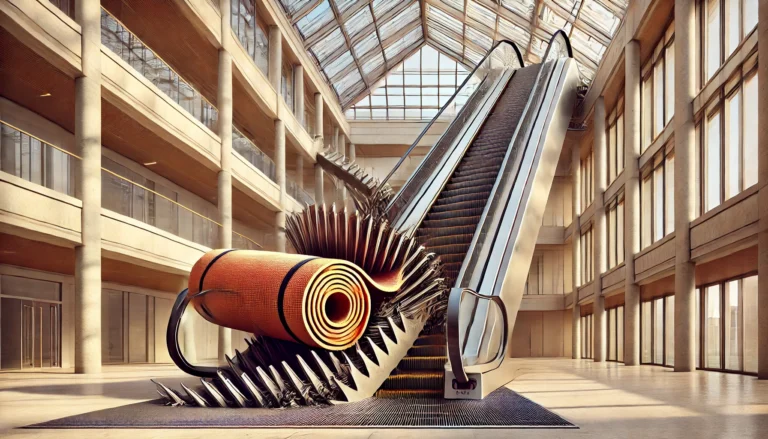
And the yoga mat? That, improbably, was what finally did in our already-aging University Hall escalators. A community member dropped one, it got pulled into the teeth of the stairs and machinery, and that was the end of a system that was already very much living on borrowed time.
Not exactly a dignified ending. But a memorable one.
The good news is that this update is less about what broke and more about what is finally moving. Yes, I’m about to report momentum on Momentum.
Escalator Demolition Begins This Weekend
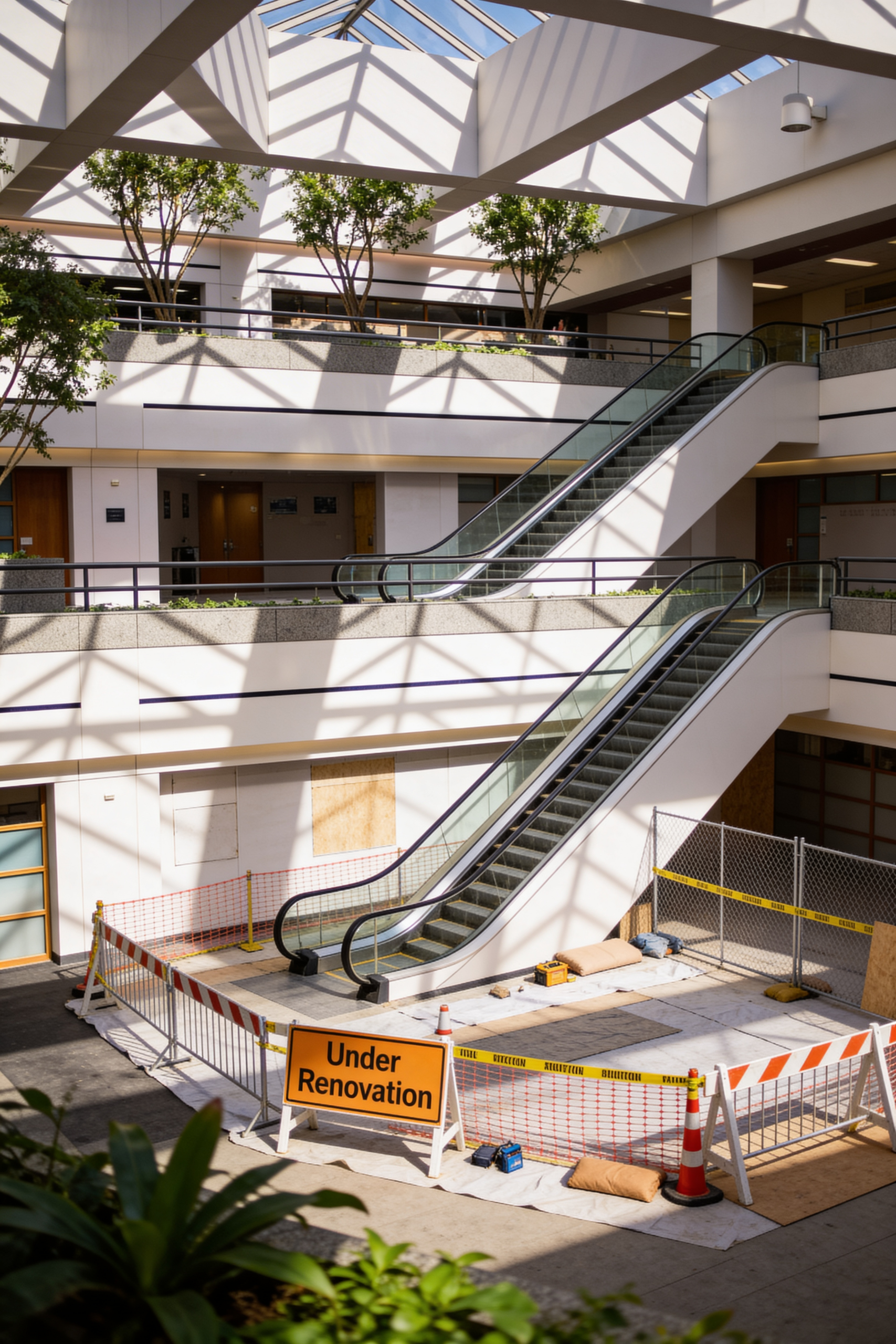
Since my January post, we’ve moved through the RFP and contractor selection process, built out the logistics and fabrication plan, and reached the point everyone has been waiting for: demolition begins Sunday, March 29.
Demolition will run for about six weeks and is expected to wrap up by Commencement. This is the part where progress becomes visible. Crews will be removing the steps, rails, internal hardware, and machinery built directly into University Hall. And because this is really four related construction projects—each escalator requires its own custom demolition and custom installation—the work is more involved than it might seem from a casual glance across the atrium floor.
Because this is happening during a crucial stretch of the semester, we are shifting the bulk of demolition to night crews, working from 10 p.m. to 7 a.m., Sunday through Thursday. That will not make the project un-disruptive, but it should keep the academic day much more manageable for students and faculty heading into the end of the semester.
You will also see noticeable signs that this is now a live construction site: larger barricades at the escalator openings, floor protection through the atrium and contractor path of travel, a fenced laydown and dumpster area near the flagpoles outside University Hall, and a fenced materials area in P1, which will affect some parking.
So yes, it is about to look like something is happening.
Why summer may look quieter
Once demolition is completed by Commencement, the project will move into the less visible phase for most of the summer. That is when inspections, custom measurements, assessments, and fabrication take over. The replacement components have to be built to fit the actual conditions revealed once the old escalators are fully removed and the area is cleaned up. That part bears repeating: the custom work can’t start until after the demo.
So if spring feels active and then summer feels slower, know that the work has simply moved behind the scenes.
And at long last – assuming the schedule holds – installation will start in August.
Meanwhile, downtown’s vertical challenges
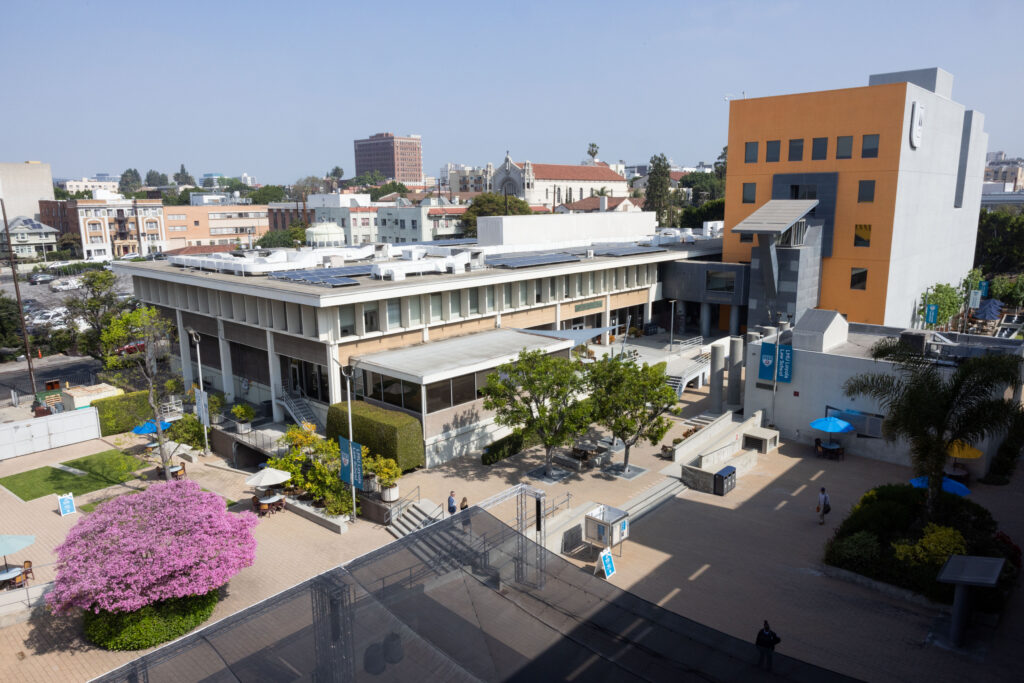
A similar story is unfolding at LMU Loyola Law School, where both elevators in the William M. Rains Library are out of service.
The original elevator dates back to 1962 and has been down for about three years. Its hydraulic system runs beneath significant portions of the building’s foundation, and restoring it would require substantial reconstruction under the main staircase, where the machinery sits. So: not exactly a quick repair.
The second elevator, installed in 1987, recently suffered a system failure of its own. Complicating matters further, because the manufacturer is no longer in business, replacement parts are nearly impossible to source, meaning repair is not a viable option.
The current full elevator replacement timeline is about 31 weeks.
That is not the answer anyone would prefer, but that’s the plain truth.
In the meantime, the law school has put accommodations in place. Members of the LMU Loyola Law School community with mobility needs may have their ID cards enabled for access to the library’s upper floors through the adjoining Casassa Building. Library staff can retrieve books and certain archival materials from the basement, and accessible study rooms have been prioritized for those with mobility needs. And visitors can contact the library front desk, Student Affairs, Campus Operations, or Public Safety for assistance.
It is not the long-term solution—but it is the right short-term move: focusing on maximum access while the larger fix is underway.
A Public Service Announcement

This is where I cue the “The More You Know” moment—because there is a broader point in all of this, and it is not just that old equipment eventually wears out. Things we depend on every day tend to last longer when we use them the way they were designed to be used.
Handrails are not benches. Elevator doors are not meant to be forced open by hand when there is a perfectly good “open” button sitting right there. And escalators, it turns out, are not improved by surprise yoga mats entering the machinery at speed.
Cars do not respond well to being slammed around. Buildings are similar.
So while this is an operational update, it’s also a small plea for patience—and maybe a little gentleness with the systems that carry all of us through our day.
And if it also persuades even one person to press the open button instead of wrestling with an elevator door, I’ll consider that a public service.
—John
Discover more from LMU COO Blog
Subscribe to get the latest posts sent to your email.