

Admit it: this is really the only blog post you care about.
When my oldest daughter learned I’d be LMU’s next COO, her immediate question was the same one I heard from nearly everyone—students, staff, faculty, alumni:
“Are you going to be able to fix the escalators?”
First: I hear you.
Second: I laughed (because of course, that’s the question).
And third: here’s the honest answer:
Yes—we’re fixing them.
None of us like those stairwells in the back of University Hall. And the delays aren’t due to a lack of effort. Context is key to understanding this issue.
University Hall—and the escalators inside it—just passed a milestone that’s easy to overlook: they’re more than 40 years old.
Those escalators have been carrying people up and down since the building first opened in the mid-1980s. They’ve been in near-constant service ever since.
So when we talk about the escalators like they’re a quick repair that should take a weekend, we skip over the real story:
These are original escalators that have reached the end of their serviceable life. And here’s the key practical detail: replacement parts are no longer manufactured.
That’s why repairs take longer than any of us would like. Over time, “routine fixes” turn into custom work, and eventually into a reality where keeping them operational becomes increasingly difficult—and ultimately unsustainable.
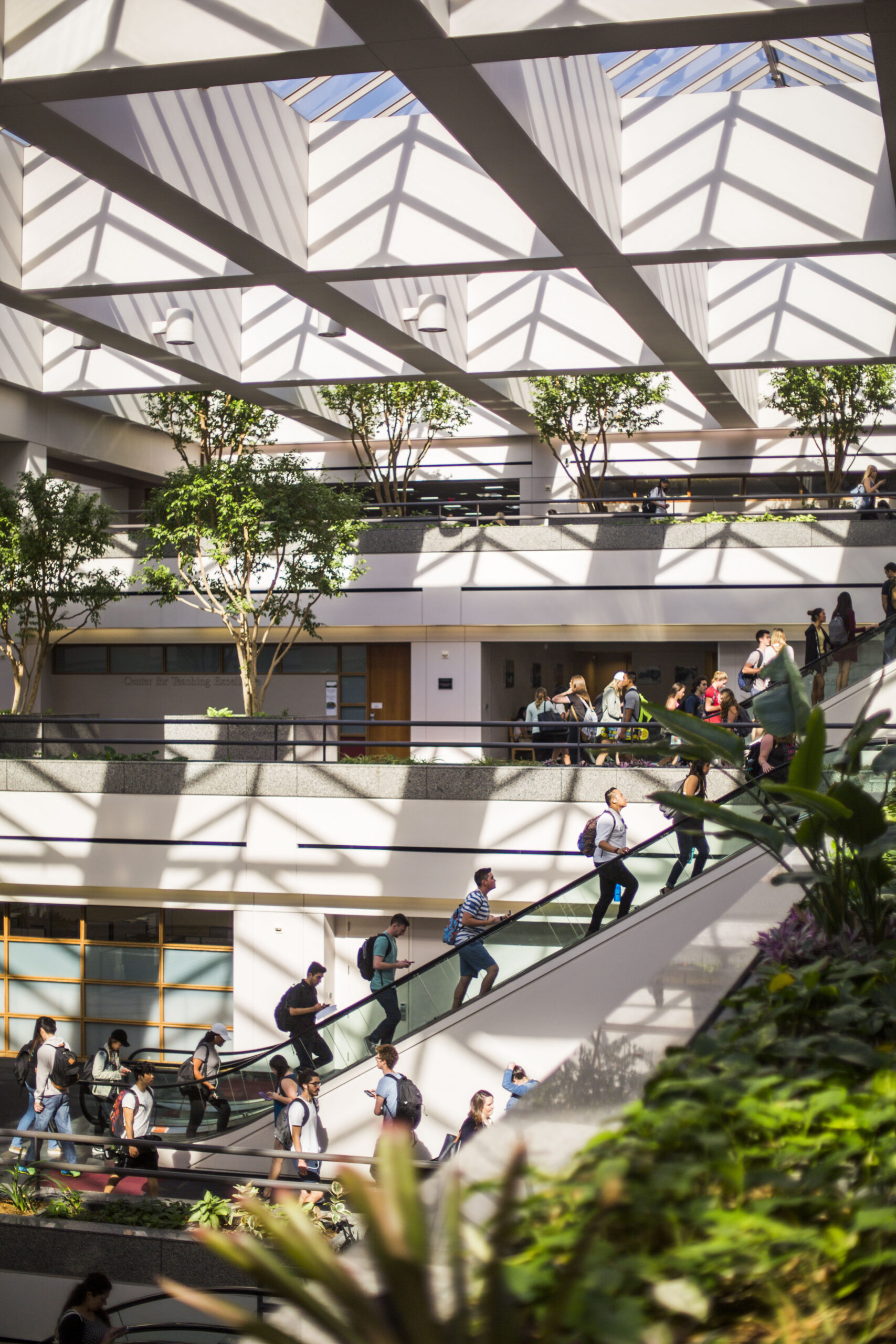
In 1985, this place was futuristic!
To understand the escalators, it helps to remember what University Hall was built to be.
In 1985, while Back to the Future was playing in movie theaters, Howard Hughes’ aerospace company was constructing a bold, purpose-built global headquarters in Westchester—carved into the bluffs, designed to be striking, and meant to signal innovation and permanence.
The building was designed by Skidmore, Owings & Merrill (SOM)—one of the world’s most prominent architectural firms—and constructed by the Koll Company, with a dramatic multi-level atrium and escalators that quite literally moved people through the space. It was widely covered, including by the Los Angeles Times, as a forward-looking corporate campus designed for the future.
At the time, the escalators weren’t a problem. They were a feature.
Fast-forward four decades, and those same escalators have become their own piece of campus lore—generating commentary, speculation, jokes, frustration, and more than a little creativity across the LMU community.
Honestly, I respect the humor. But I respect the underlying message even more: this matters to your daily experience, and you’re tired of it being a recurring issue.
So am I.
So what’s happening now?
We are replacing the University Hall escalators.
Last fall, the LMU Board of Trustees approved a multi-million-dollar investment to replace and modernize the escalators. That decision moves us from keeping a legacy system on life support to delivering a durable, long-term solution.
As Mike Wong, our vice president for Facilities Management, has shared, “Our facilities team has explored every viable option before moving to a full replacement. In this case, the escalators are original to the building, and the parts needed to keep them running simply aren’t available anymore. At a certain point, replacement becomes the only responsible path forward.” And thanks to Mike and the FM team for repairing these aging escalators—when they break because of age or they break because someone sat on a handrail. But we’re out of fixes.
Why it still takes time
If this were as simple as ordering a replacement part, we’d already be done. But this project has to move at the pace required for safety, permitting, and responsible stewardship—especially in a heavily used building like University Hall. If we can find ways to make it happen faster, we will.
Even with funding approved, there are important steps to complete:
- The City of Los Angeles is reviewing and approving our plans, as required for a project of this scope.
- We are negotiating contracts and securing the right partners to deliver a safe, durable, long-term solution.
- We are sequencing construction carefully in a high-traffic building so access, safety, and continuity are maintained throughout the project.
Once construction begins, the replacement itself is expected to take approximately six months to complete.
Our current estimate is that construction will begin in summer 2026, pending final approvals and contracting. I know that’s not the instant-gratification answer—but it’s the honest one, and it’s how we move this from a recurring frustration to a resolved issue.
Mythbusters (because this is a COO blog)
Myth: “They just don’t want to fix them.”
Fact: Keeping 40-year-old escalators running without manufactured replacement parts is like relying on a classic car for your daily commute when the parts aren’t made anymore. You can do it—until you can’t. And when you can’t, the responsible move is replacement.
Myth: “This should be a quick repair.”
Fact: Once parts aren’t produced, every fix becomes slower, less predictable, and more complex—especially when safety and code compliance are non-negotiable.
What I’m committing to as your COO
This is exactly the kind of issue I talked about in my first post: highly visible, high-friction, and—honestly—a little symbolic.
Because escalators aren’t just escalators.
They’re about reliability.
They’re about whether the campus experience feels smooth or needlessly difficult.
And they’re about whether we tackle recurring problems with long-term solutions.
So yes—we’re fixing them.
And as we move through approvals, contracting, and construction, I’ll use this blog to keep you updated : what’s next, what’s taking time, and what you can expect.
And one last public service announcement: please don’t ride the handrails. It’s unsafe, it breaks the equipment, and future Lions will thank you for letting the new escalators age with grace.
—John
Discover more from MOMENTUM COO Blog
Subscribe to get the latest posts sent to your email.